Doma Season 1 Badges: Genesis Founder and Day 1 Genesis Explained
Covers how Doma Season 1 badges work, their eligibility rules, rewards, and key differences. After reading, you will understand exactly what each badge grants and how future seasons may build on this system.
→Distinguish DOTs for domain ownership from DSTs for DNS control
→Recognize bonding curves as the gating mechanism for badge eligibility
→Understand the $SOFTWARE.ai single-block exception for Genesis Founder qualification
→Calculate net spend correctly to verify Day 1 Genesis Badge eligibility
$38M+
Mainnet trading volume
000+
Tokenized domains
500+
Connected wallets
3
Domains eligible for Genesis Founder Badge (ever)
01
What Are Doma Season 1 Badges and Why Do They Matter?
Doma Season 1 Badges are permanent, non-transferable on-chain credentials attached to your wallet that give you an additive advantage every time you trade on the Doma Protocol. They are not cosmetic profile pictures or tradeable collectibles. They are economic multipliers — small percentage boosts to the trading points you earn, applied automatically to every transaction you make on the platform, for as long as you use it.
The exact token standard used for these soulbound badges (whether ERC-5192, ERC-4973, or a custom non-transferable implementation) has not been publicly documented by the team. What is confirmed is that they cannot be transferred between wallets and are permanently bound to the address that earned them. This also means that, in principle, a contract upgrade could alter their properties — though there is no indication the team plans to do so.
Two badge types exist. The Genesis Founder Badge (gold) was available only to participants in the first three fractionalized domain launches and is now permanently closed. The Day 1 Genesis Badge (blue/silver) is available for any fractionalized domain launched before a hard deadline of midnight UTC on 1 April 2026. Both grant a 1% lifetime boost to trading points. The Genesis Founder Badge carries an additional 2× retroactive multiplier on Season 0 points for the three original tokens — a benefit the Day 1 Genesis Badge does not include.
Whether the 1% boosts from both badges stack has not been publicly confirmed by the Doma team. If you hold both badges, do not assume you receive a combined 2% boost until official documentation confirms stacking mechanics. This guide flags this as an open question wherever it is relevant.
This guide exists to document exactly how both badges work, clarify the details that most summaries get wrong, and help you understand the system that future Doma seasons will build upon. If you hold either badge, you should understand precisely what you have. If you missed them, you should understand what to watch for next.
What this means for you: These badges set the template for how Doma rewards early participants — grasping this system now prepares you for whatever Season 2 introduces.
By the numbers
$38M+
Mainnet trading volume
000+
Tokenized domains
500+
Connected wallets
3
Domains eligible for Genesis Founder Badge (ever)
02
How Doma Tokenises Real Internet Domains
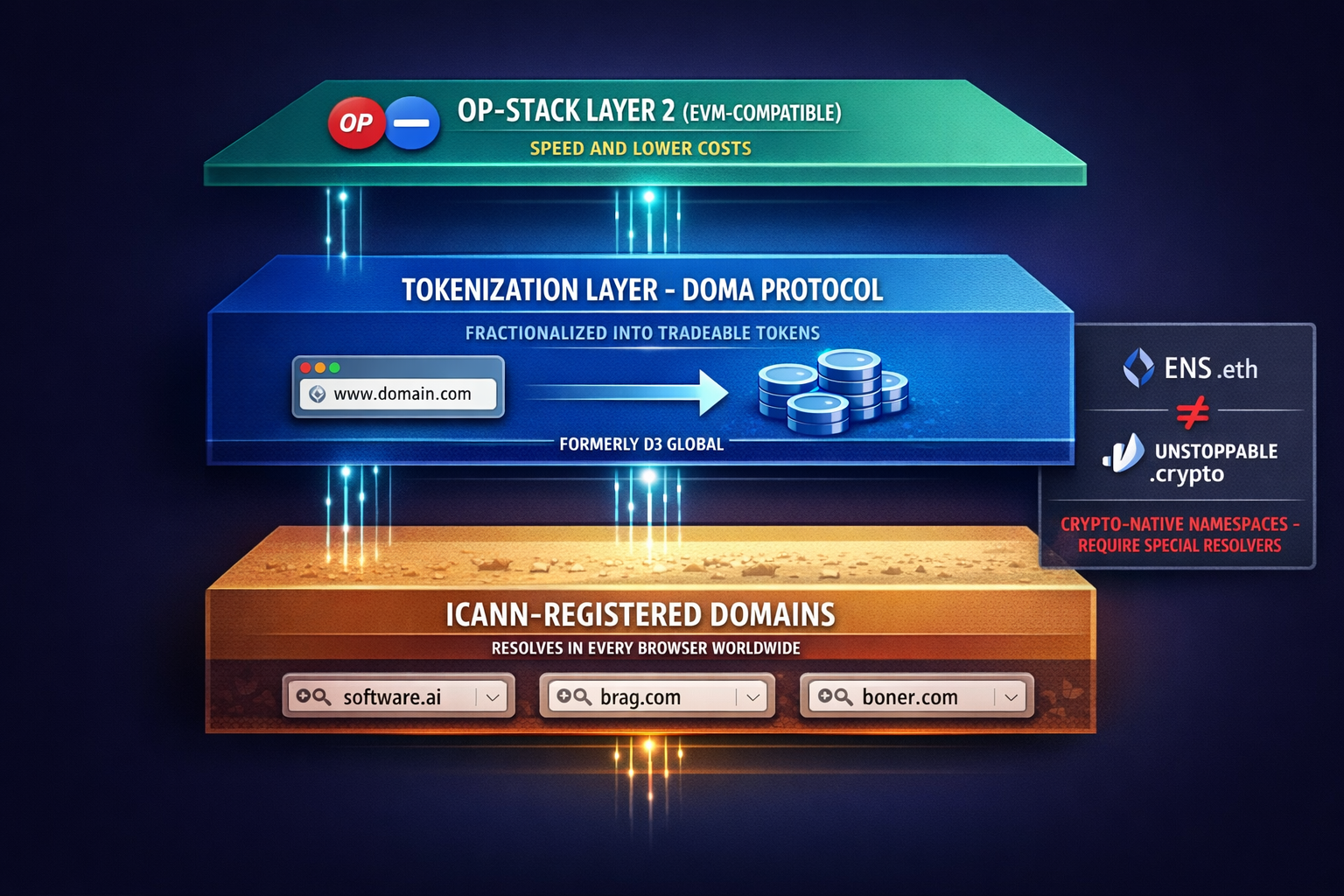
A layered anatomy diagram showing ICANN domains at the base, tokenization in the middle, and the OPS
Before badges make sense, you need to understand what you are actually trading on Doma.
Most explainers mistakenly group Doma with crypto-native naming systems like ENS (.eth) or Unstoppable Domains (.crypto). The difference is fundamental: those projects create new namespaces that require special resolvers; Doma tokenises existing ICANN-registered domains that already resolve in every browser.
Doma Protocol (formerly known as D3 Global, now operating under the Doma brand) tokenises traditional internet domains — the .com, .ai, and .xyz addresses that already work in every browser on the planet. It is an EVM-compatible Layer 2 (a blockchain that sits on top of Ethereum for speed and lower costs) using the OP Stack (the same open-source framework that powers Optimism and Base). Doma is not a registrar — it does not sell domains. It partners with registrars like InterNetX (which manages over 20 million domains), NicNames, EnCirca, and others to bring existing domain inventory on-chain.
The core innovation is a dual-token system:
›DOTs (Domain Ownership Tokens): Tokens that represent the title and transfer rights to a domain. The exact token standard used for DOTs requires clarification — if each DOT represents a unique claim on a specific domain, one would expect an NFT standard (ERC-721) or semi-fungible standard (ERC-1155) rather than a fungible ERC-20. Doma's documentation has described them as ERC-20, but this is counterintuitive for a unique asset. Think of a DOT as functionally similar to a digital title record for a property — though it is important to note this is an illustrative analogy, not a legal equivalence. A smart contract token does not carry the same legal weight as a recorded property deed in any jurisdiction (see the Risks and Limitations section below for more on this).
›DSTs (Domain Service Tokens): Separate tokens that control the domain's DNS records and nameservers — the technical settings that tell the internet where to find a website or route email. Separating this from ownership means you can sell a domain's title while the website and email keep running, or lease out DNS control while retaining ownership.
Legal Ownership: What Token Holders Actually Own
This is the most important question in the entire model and one that is not sufficiently addressed in most Doma explainers. When you hold a DOT or fractionalized domain tokens, you own tokens on a blockchain. You do not become the registrant of record at the ICANN/registrar level. The underlying domain remains registered through Doma's registrar partners (such as InterNetX), who serve as custodians of the actual domain registration.
The legal relationship between your token and the domain depends on the contractual agreements between Doma, its registrar partners, and you as a token holder. Key questions that prospective participants should investigate:
›Who is the registrant of record? The registrar partner, not the token holder, is typically listed as the registrant at the ICANN level.
›What legal agreement backs the token-to-domain relationship? Review Doma's terms of service to understand what obligations the protocol and registrar partners assume toward token holders.
›What recourse exists if the registrar or Doma ceases operations? If the registrar revokes the underlying domain or Doma's L2 goes offline, the enforceability of your token-based claim is unclear and untested in court.
On top of the dual-token system, Doma enables fractionalization. A domain owner locks their domain as an NFT (a unique digital asset on the blockchain) on Doma, and the protocol mints fungible ERC-20 tokens representing fractional ownership. The default supply appears to be 10,000 tokens per domain, though this may be configurable — verify the token supply for any specific domain before purchasing. Those tokens can then trade on decentralised exchanges. For example, the domain software.ai was fractionalized into tokens trading under the ticker $SOFTWARE. Traditional domain aftermarket brokers typically charge 10–25% in commissions (Sedo charges 15–20%, Afternic/GoDaddy 20–25% for broker-assisted sales, Dan.com charges 9% for direct sales), and complex transactions involving escrow can take days to weeks — sometimes 30–60+ days. Fractionalized domain tokens settle instantly, with no broker.
To participate, you need USDC (a stablecoin pegged to the US dollar) or ETH in your wallet on Doma's Layer 2 chain. On Doma's L2, stablecoins circulate as USDC.e — the bridged version of USDC. If you do not already hold USDC or ETH, a centralised exchange like MEXC lets you purchase USDC with fiat before bridging it to Doma's chain.
What this means for you: When you buy a fractionalized domain token on Doma, you are buying a token that represents a claim on a share of a real internet domain — one that works in Chrome, Safari, and every other browser. However, token ownership is not the same as legal domain registration. Understand the custodial and legal structure before committing significant funds.
03
How to Bridge USDC to Doma's Layer 2
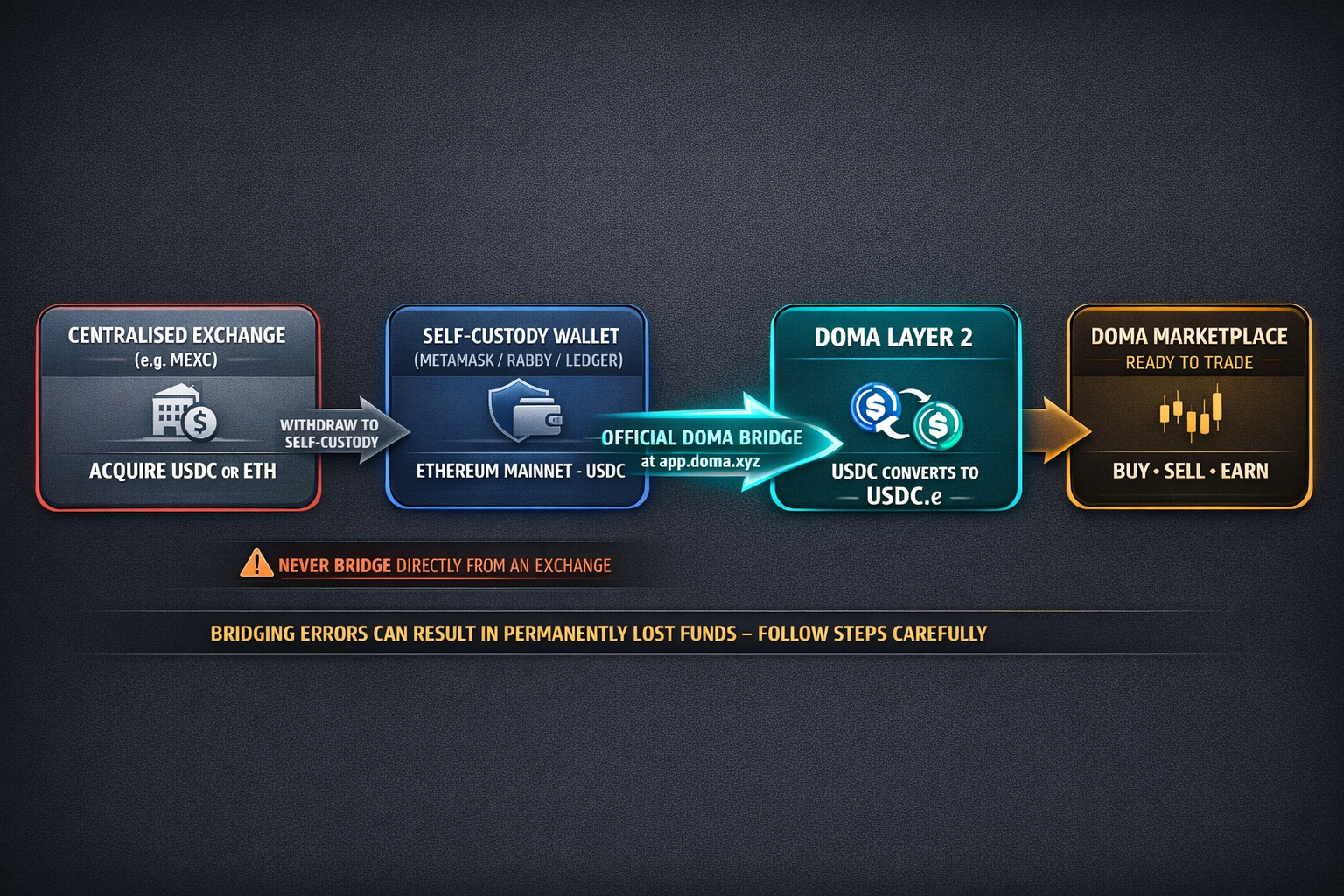
A stepbystep fundflow diagram showing the path from a centralised exchange through a selfcustody wal
Doma operates on its own Layer 2 chain. You cannot buy fractionalized domain tokens using USDC sitting on Ethereum mainnet — you must first bridge it to Doma's L2, where it becomes USDC.e. Bridging errors can result in permanently lost funds, so follow these steps carefully:
1. Acquire USDC or ETH on a centralised exchange like MEXC or on Ethereum mainnet.
2. Send USDC to your own wallet (e.g., MetaMask, Rabby, or a hardware wallet like Ledger) on Ethereum mainnet. Do not attempt to bridge directly from an exchange.
3. Navigate to Doma's official bridge. Access it through app.doma.xyz (note: this is a referral link — see disclosure at the end of this guide). Look for the bridge function within the app interface.
4. Connect your wallet to the bridge interface.
5. Select the asset (USDC or ETH) and the amount you wish to bridge.
6. Confirm the transaction on Ethereum mainnet. You will pay an Ethereum gas fee for this transaction. Wait for the bridge to process — this may take several minutes to an hour depending on network conditions.
7. Verify arrival. Once bridging completes, your wallet on Doma's L2 should show USDC.e (or ETH). Confirm the balance before attempting any purchases.
Important: Only use the official bridge linked from Doma's app. Never use third-party bridges or links from unofficial sources. If the bridged funds do not appear after a reasonable period, check the transaction on a block explorer before initiating any further transactions.
What this means for you: Bridging is a required step before you can trade on Doma. Take your time, use the official bridge, and verify your balances before proceeding.
04
Bonding Curves: The Mechanism That Determines Badge Eligibility
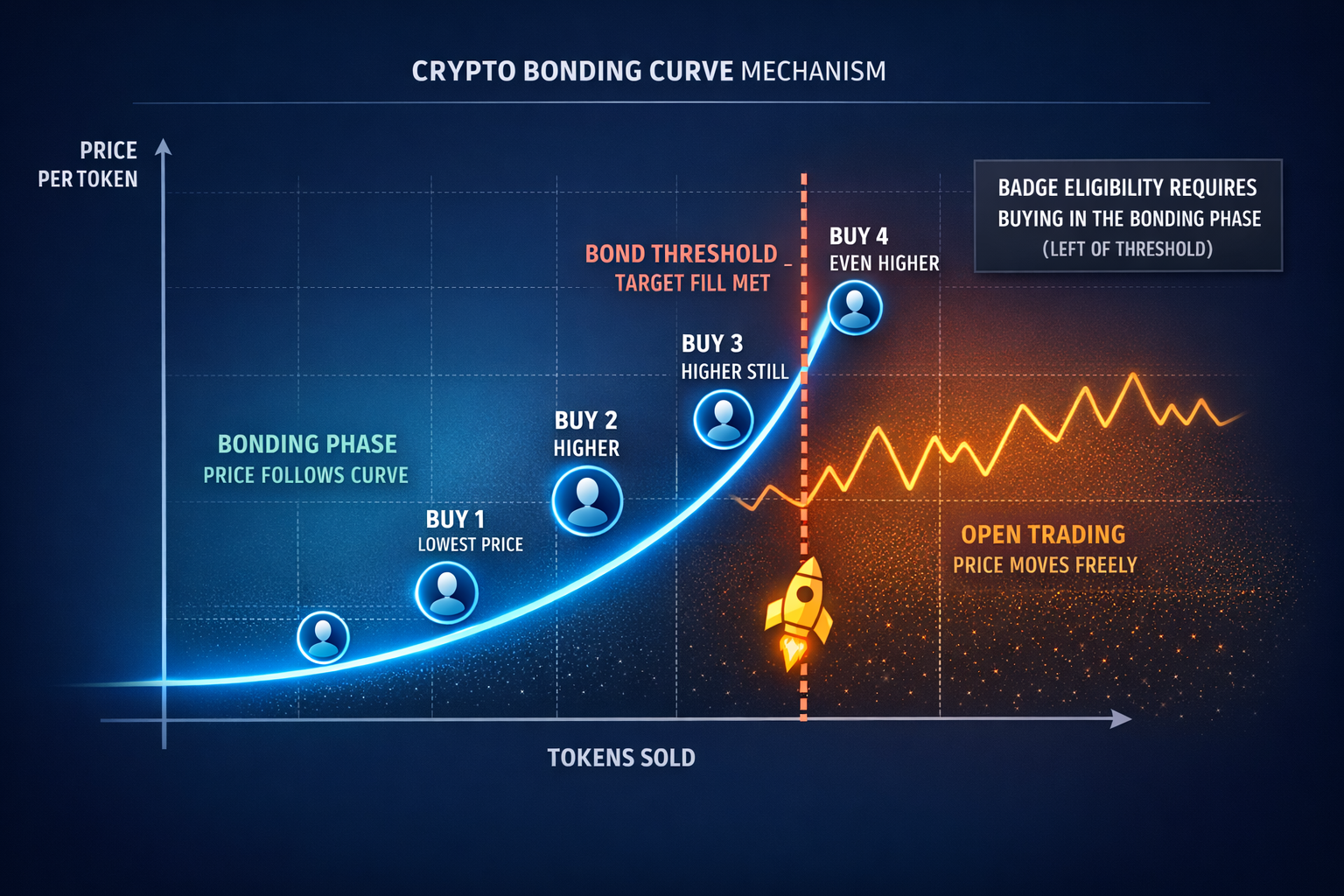
A pricevssupply bonding curve diagram showing how token price rises with each purchase until hitting
[VISUAL:...]
A bonding curve is an automated pricing mechanism that controls the initial sale of a fractionalized domain token. During the bonding phase, the price follows a predetermined curve that rises with each purchase — the more tokens sold, the higher the next buyer pays. This curve only applies during the initial sale; once the token bonds and hits the open market, the price moves freely in both directions.
The specific shape of the bonding curve (whether linear, exponential, or sigmoid) has not been publicly documented in detail. What is known is that each curve has a target fill amount — a total purchase volume threshold that, once met, causes the token to bond (graduate from the curve to open trading on decentralised exchanges).
Both Doma badges require buying during or around this bonding phase. This is the protocol's way of rewarding the people who took the earliest risk — buying a token before anyone knew whether enough demand existed for it to graduate.
What happens if a bonding curve never fills?
This is a critical question the protocol has not fully addressed in public documentation. If a bonding curve fails to attract enough buyers to reach its target, the token does not graduate to open trading. For badge purposes, purchases of tokens that never bond do not count toward Day 1 Genesis Badge eligibility. Whether buyer funds are refunded, tokens are burned, or some other mechanism applies when a curve fails should be verified in Doma's documentation before participating in any bonding curve.
Timing dynamics
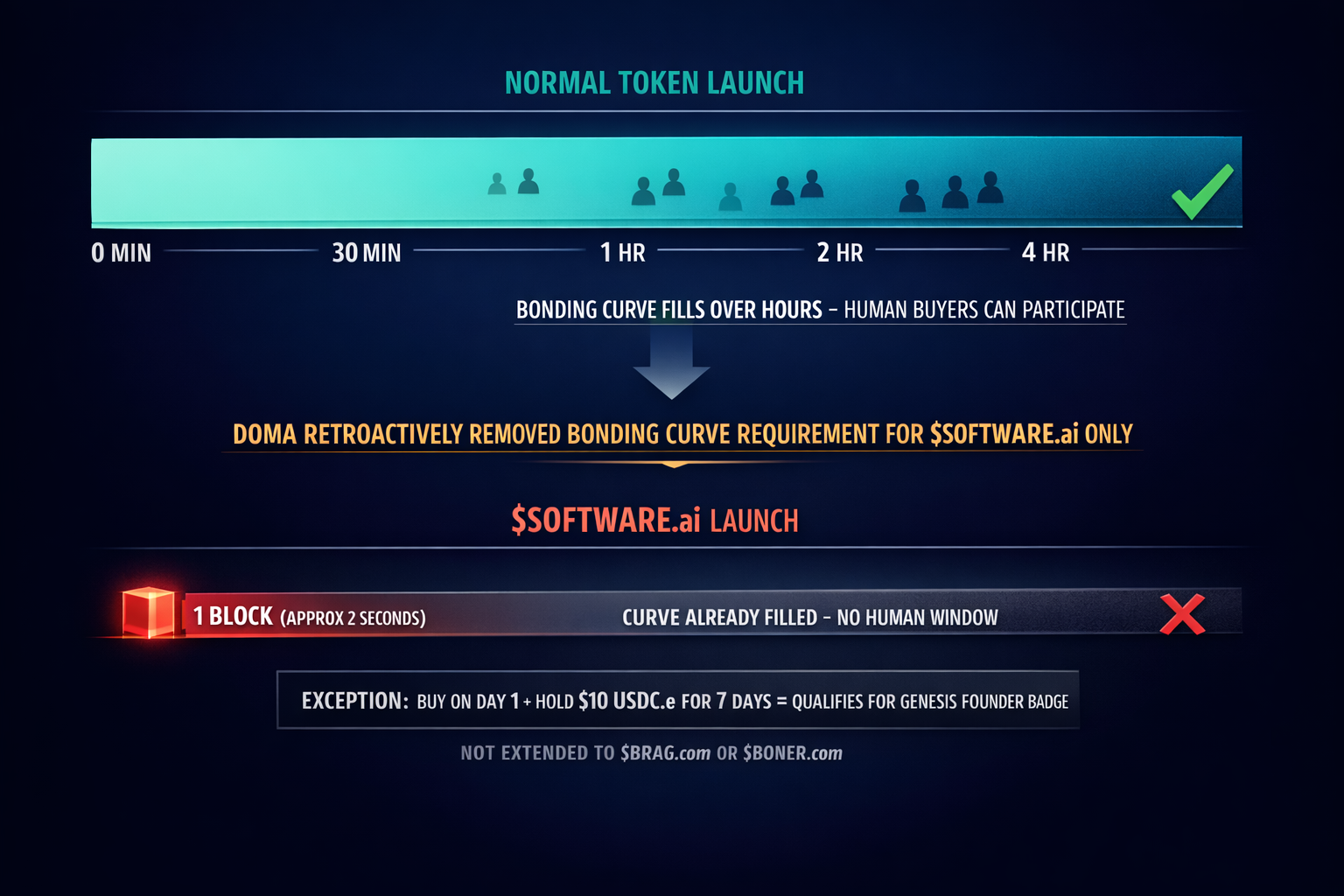
Here is the critical timing issue: some domains bond extremely fast. The token for software.ai ($SOFTWARE) bonded in a single block — meaning every purchase needed to fill the curve happened within one block of transactions, which can be as short as a few seconds. Other domains might take hours or even fail to attract enough buyers to bond at all.
›If a domain bonds too fast, you might not be able to buy during the bonding curve even if you were watching the launch live
›If a domain never bonds, your purchase does not count toward the Day 1 Genesis Badge — one of the five requirements is that the domain must successfully bond
›After bonding, prices can and do decline. The bonding curve guarantees a rising price only during the initial sale. Once the token graduates, it trades on the open market where supply and demand determine the price. Tokens can and have traded below their bonding-curve price after graduation.
What this means for you: Badge eligibility is not just about showing up and buying. It depends on when you buy relative to the bonding curve and whether the curve completes — variables that are partially outside your control. And even if you earn a badge, the token you bought may decline in value after bonding.
05
Season 0: What It Was and Why It Matters for Badge Value
The Genesis Founder Badge's 2× retroactive multiplier applies to Season 0 trading points. To evaluate whether that multiplier is meaningful for any given holder, you need to understand what Season 0 was.
Season 0 was the initial trading period on the Doma platform, encompassing the earliest fractionalized domain launches — specifically including $SOFTWARE.ai, $BRAG.com, and $BONER.com. During Season 0, users earned trading points through buying and selling activity on these tokens. The exact start and end dates of Season 0, the specific activities that earned points, and the rate of point accrual during that period have not been comprehensively documented by the team in public-facing materials.
What is known:
›Season 0 points were earned through trading activity on the Doma marketplace during the pre-Season 1 period
›The retroactive multiplier only applies to Season 0 points earned on the three original tokens ($SOFTWARE.ai, $BRAG.com, $BONER.com)
›The multiplier was applied after badge award, meaning holders should see updated point balances in their profiles
›Testnet participants also received retroactive point allocations added to their Season Testnet points
The practical implication: the Genesis Founder Badge's value varies dramatically between holders. A trader who was heavily active in Season 0 on $BRAG.com receives a far larger retroactive boost than someone who made a single qualifying purchase and did nothing else. The badge rewards depth of early engagement, not just presence.
What this means for you: If you hold a Genesis Founder Badge, check your profile to see whether your Season 0 points have been recalculated. If you were not active during Season 0, the retroactive multiplier adds nothing to your balance — though you still retain the 1% lifetime boost.
06
Genesis Founder Badge: The Gold Standard
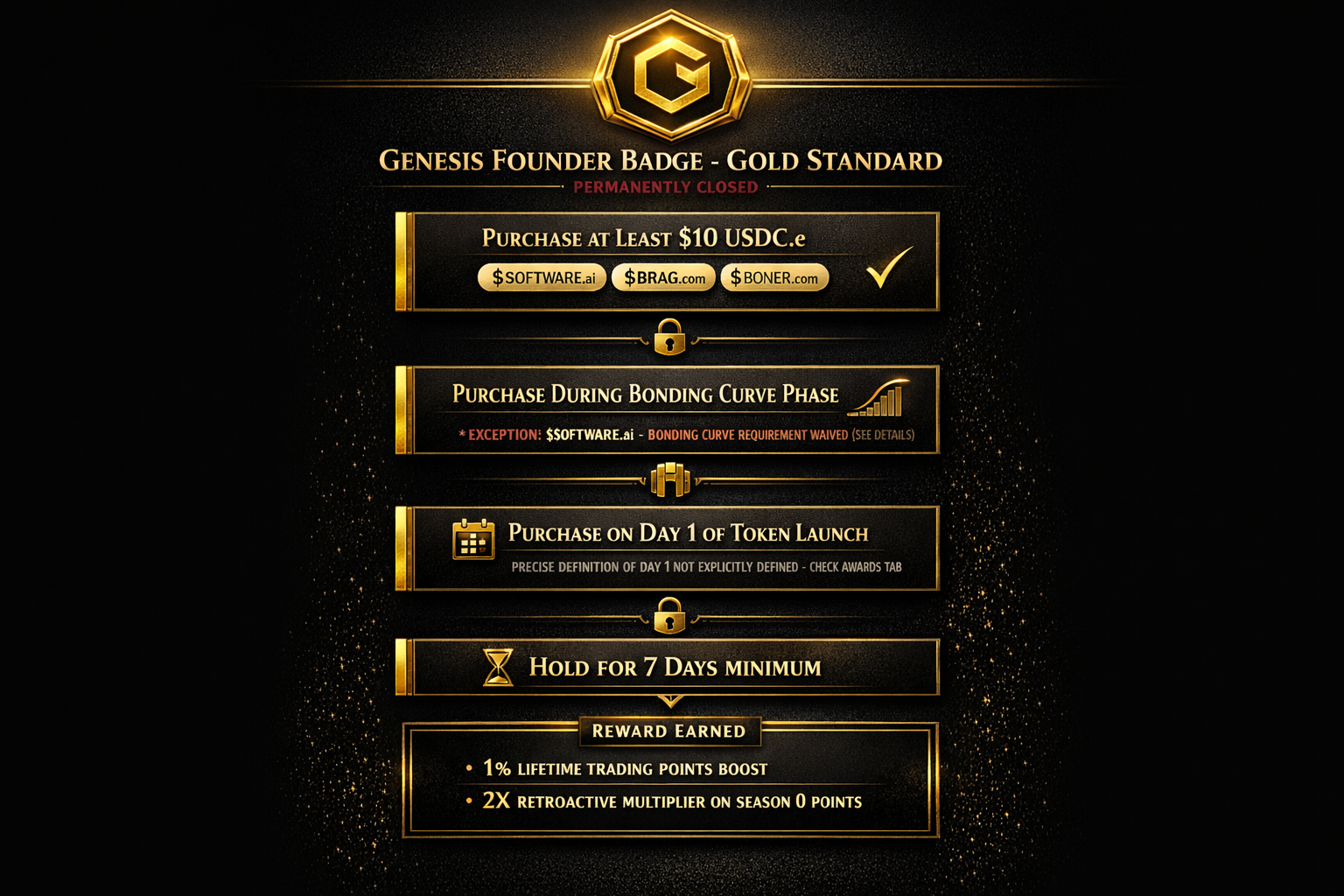
A sequential fourstep eligibility checklist for the Genesis Founder Badge with gated requirements sh
[VISUAL:...]
The Genesis Founder Badge is the highest-tier credential in Doma's badge system. It is gold-coloured, permanently closed to new earners, and carries a double reward that no other badge matches.
Eligibility (all four conditions must be met)
1. Purchased at least $10 USDC.e of $SOFTWARE.ai, $BRAG.com, or $BONER.com
2. Purchased while the token was still in its bonding curve (with one exception — covered below)
3. Purchased on Day 1 of the token's launch — the precise definition of "Day 1" (whether it means the first 24 hours from the block in which the bonding curve was deployed, or the first UTC calendar day of launch) has not been explicitly defined in public documentation. If you purchased within the first 24 hours of a token's launch and are unsure whether it counts, check the Awards tab in your profile for confirmation.
4. Held at least $10 USDC.e worth of the token for 7 consecutive days
Reward
›1% lifetime trading point boost on all domains — not just the three qualifying tokens, but every domain you ever trade on Doma, for the life of the wallet
›2× retroactive multiplier on trading points earned during Season 0 for $SOFTWARE.ai, $BRAG.com, and $BONER.com specifically — this means your historical Season 0 points on those three tokens are doubled after badge award
›Testnet participants also receive retroactive point allocations added to their Season Testnet points
Why the reward structure matters more than it appears
The 1% lifetime boost is a flat, permanent, additive edge. On its own, 1% sounds trivial. But trading points accumulate with every transaction. The benefit scales linearly — the more you trade, the more additional points you accumulate from the boost. It is not compounding in the exponential sense; it is the same 1% added on top of every trade. Over hundreds or thousands of trades, that consistent addition becomes meaningful.
The 2× retroactive multiplier is the piece that separates Genesis Founder from every other badge. It reaches back in time to double your Season 0 points on the three original tokens. This means the badge's value is not equal for all holders. A trader who was heavily active in Season 0 on $BRAG.com receives a far larger retroactive boost than someone who made a single qualifying purchase and did nothing else.
The Genesis Founder Badge includes every benefit of the Day 1 Genesis Badge plus the 2× retroactive Season 0 multiplier, and it required participation in a narrower, now-closed eligibility window.
What this means for you: If you hold a Genesis Founder Badge, your Season 0 point balance has already been recalculated. Check your profile to see the updated totals.
07
The $SOFTWARE.ai Exception — And What It Reveals
A timeline contrasting the nearinstant singleblock bonding curve fill of SOFTWAREai with a normal mu
[VISUAL:...]
When software.ai was fractionalized, demand was so intense that every purchase needed to fill the bonding curve landed in a single block. On an EVM-compatible Layer 2, a block can be produced in as little as two seconds. That means the window to "buy during the bonding curve" — one of the four Genesis Founder Badge requirements — effectively did not exist for human participants.
Doma's response: they retroactively removed the bonding-curve purchase requirement for $SOFTWARE.ai only. If you bought $SOFTWARE.ai on Day 1 and held $10+ USDC.e worth for 7 days, you qualify for the Genesis Founder Badge — even though you technically purchased after the token had already bonded.
This exception has not been extended to $BRAG.com or $BONER.com, where bonding dynamics apparently allowed enough time for participants to buy during the curve.
What this precedent reveals
The single-block bonding of $SOFTWARE.ai was almost certainly driven by automated sniping bots or large buyers who submitted transactions the instant the bonding curve opened. On EVM-compatible chains, this is a known dynamic — bots can monitor pending transactions and submit purchases within the same block that a bonding curve deploys, leaving human participants unable to participate during the bonding phase. (This is related to but distinct from MEV — maximal extractable value — which technically refers to value extracted by block producers or searchers through transaction reordering, insertion, or censorship. The $SOFTWARE.ai case is more accurately described as automated sniping: bots buying faster than humans can react.)
The team's willingness to adjust eligibility criteria retroactively when conditions made the original rules impossible to satisfy is worth noting. It signals that Doma's badge system is designed with intent to reward genuine early participation, not to create arbitrary gatekeeping. Whether future seasons adopt similar flexibility remains unknown.
What this means for you: If you participated in any of the three original launches, check your badge status even if you assumed you did not qualify — the $SOFTWARE.ai exception may have made you eligible.
⚠
$SOFTWARE.ai bonded in a single block
The entire bonding curve was consumed in one block of transactions — too fast for any human to buy during bonding. Doma removed the bonding-curve requirement for $SOFTWARE.ai only. This exception applies to no other domain.
08
Day 1 Genesis Badge: The Blue Entry Point
The Day 1 Genesis Badge (blue/silver) is the broader, more accessible of the two badges. It is not limited to the first three domains — any fractionalized domain launched on Doma can qualify. However, it comes with its own hard boundary: a purchase deadline of midnight UTC on 1 April 2026.
Important note on timing: As of the time of writing, this deadline may not yet have passed. If you are reading this before 1 April 2026, the Day 1 Genesis Badge window may still be open — verify the current date and check the Doma platform for confirmation. If you are reading this after 1 April 2026, the window is closed.
Eligibility (all five conditions must be met)
1. $10 USD minimum net spend — this is buys minus sells, not total purchase volume. If you bought $50 and sold $45, your net spend is $5, and you do not qualify
2. Domain must still be in its Day 1 bonding period at the time of your purchase — meaning you must purchase on Day 1 while the bonding curve is still open. If a domain's bonding curve fills in the first hour of Day 1, purchases made later on Day 1 (after the curve has already completed) may not qualify under this criterion, as the bonding period has technically ended even though Day 1 has not.
3. Purchase made before midnight UTC on 1 April 2026
4. 7-day minimum holding period — you must hold at least $10 worth for 7 consecutive days
5. The purchased domain must successfully bond — if the bonding curve never fills, the purchase does not count
Reward
›1% lifetime trading point boost on all domains — identical in structure to the Genesis Founder Badge's flat boost
›No retroactive Season 0 multiplier. That component is exclusive to the Genesis Founder Badge.
The net spend trap
This is where most explanations go wrong when describing the Day 1 Genesis Badge. The requirement is net spend, not gross spend. Active traders who bought and sold fractionalized domain tokens during Day 1 may have generated significant gross volume but ended up with net spend below $10. If you bought $200 worth of a token, sold $195 to take quick profit, and held only $5 net — you did not qualify, despite having moved hundreds of dollars through the system.
What this means for you: If the 1 April 2026 deadline has not yet passed, you may still be able to earn this badge. If it has passed, check your Awards tab to confirm whether you earned it.
09
Side-by-Side: Genesis Founder vs. Day 1 Genesis
A structured comparison table contrasting Genesis Founder and Day 1 Genesis badges across five dimen
[VISUAL:...]
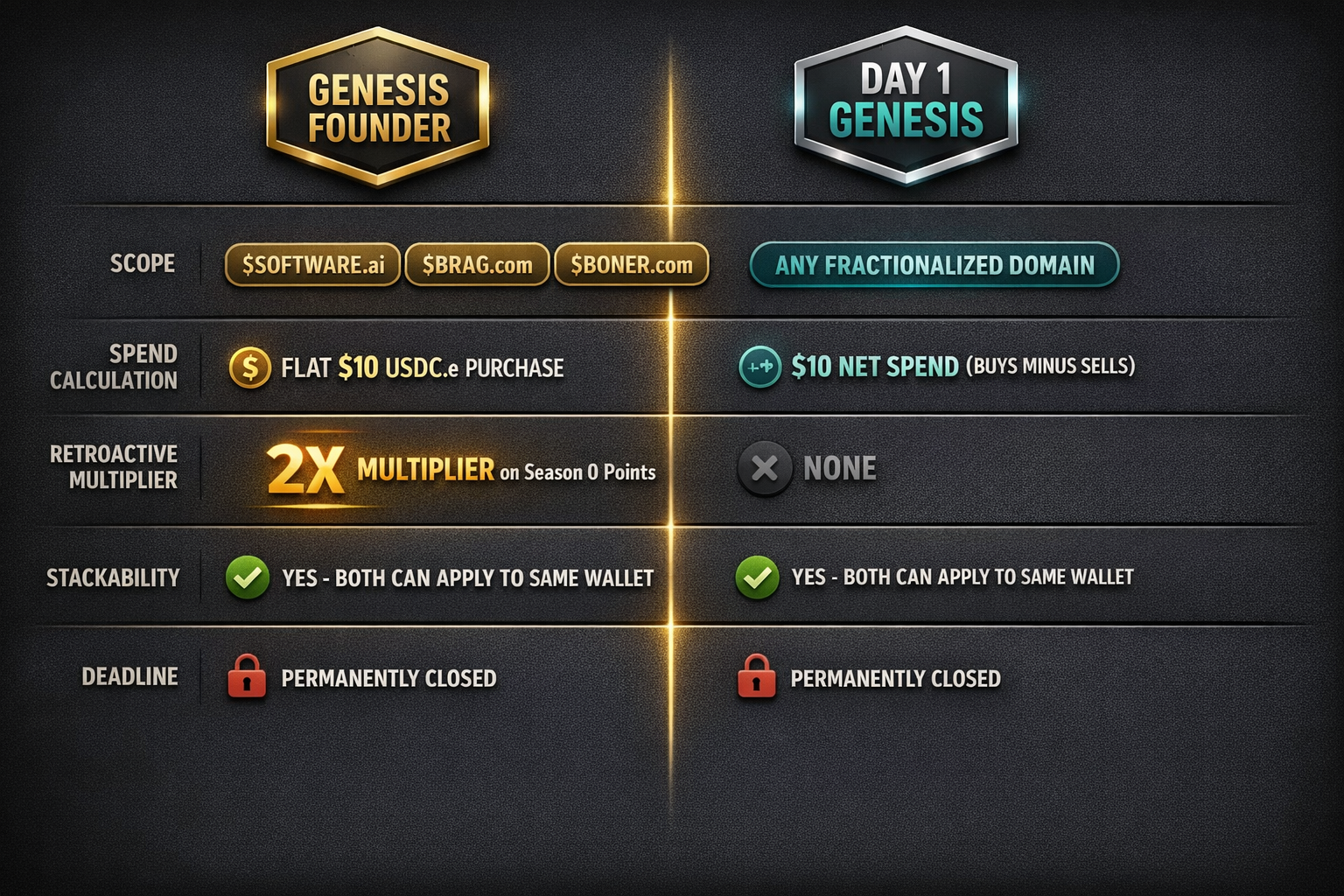
The key differences come down to scope and reward depth:
›Scope: Genesis Founder is exclusive to three tokens ($SOFTWARE.ai, $BRAG.com, $BONER.com). Day 1 Genesis covers any fractionalized domain.
›Spend calculation: Genesis Founder uses a flat $10 USDC.e purchase threshold. Day 1 Genesis uses $10 net spend — buys minus sells.
›Retroactive multiplier: Only Genesis Founder holders receive the 2× multiplier on Season 0 points for the three original tokens. Day 1 Genesis holders receive no retroactive component.
›Can you hold both? Logically, yes — if you met the Genesis Founder criteria on one of the three original tokens and also made a qualifying Day 1 purchase on a different fractionalized domain before the deadline, both badges would apply to your wallet. However, whether the two 1% boosts stack (giving an effective 2% boost) has not been publicly confirmed by the Doma team. Do not assume stacking until this is officially documented.
What this means for you: The Genesis Founder Badge is the more powerful credential — it includes everything the Day 1 Genesis Badge offers, plus the 2× retroactive Season 0 multiplier, and it required participation in a narrower eligibility window.
10
What We Know (and Don't Know) About Trading Points
A beforeandafter bar chart showing base trading points, the 1 uplift from one badge, and the hypothe
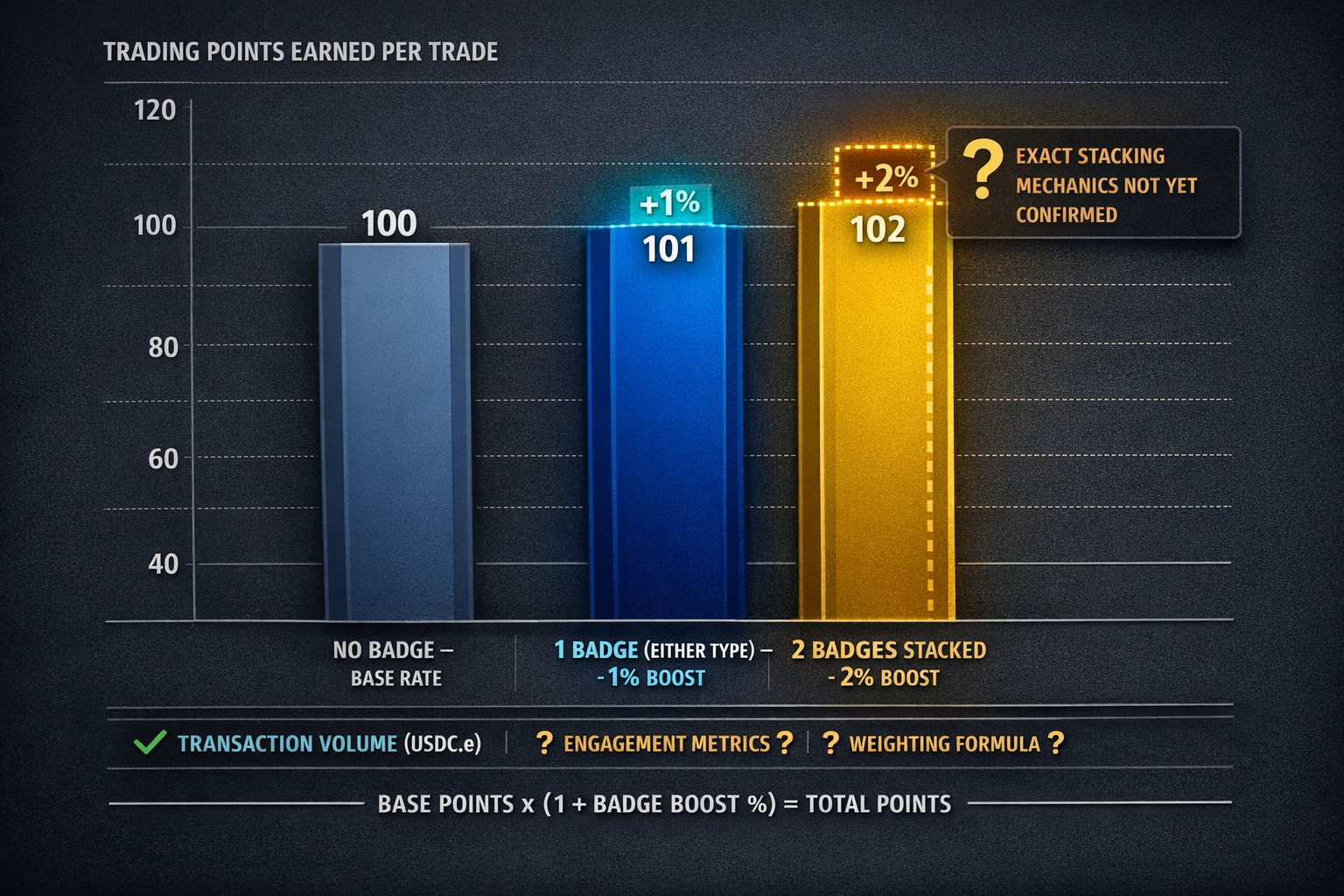
Trading points accrue on every buy and sell executed on Doma's marketplace. The exact accrual formula has not been publicly documented. Confirmed factors include transaction volume (in USDC.e). The team has indicated that "engagement" also plays a role, but has not disclosed what specific engagement metrics are measured or how different factors are weighted. Badges modify the rate at which you earn those points.
Here is how the maths works for the 1% lifetime boost, based on what is confirmed:
›Without a badge, you earn the base rate of trading points for each trade
›With one badge (either type), you earn 1% more points for that same trade — an additive increase applied to each transaction
›If both badges stack (unconfirmed), you would earn 2% more points — but exact stacking mechanics have not been publicly confirmed. Do not assume stacking.
The 1% boost is additive, not compounding. You receive an extra 1% on every trade, and the benefit grows linearly with the number of trades you make. It does not create exponential growth — each trade simply receives the same flat percentage increase. Over hundreds or thousands of trades across an expanding marketplace, the cumulative additional points become significant, but the rate is constant.
The 2× retroactive multiplier on the Genesis Founder Badge works differently. It does not apply going forward. It reaches back into your Season 0 trading history and doubles all points you earned from trading $SOFTWARE.ai, $BRAG.com, and $BONER.com during that period. If you earned 5,000 Season 0 points on $BRAG.com trades, your balance becomes 10,000.
What this means for you: The 1% boost is small per trade but permanent and universal. Its value scales linearly with your trading activity across the ecosystem.
11
What Will Trading Points Be Worth?
The team has not confirmed what trading points will convert into. Speculation in the community centres on a future token airdrop, governance allocation, or fee-sharing mechanism, but none of these has been officially announced. Do not treat points as having a guaranteed monetary value.
Here is what is confirmed:
›Points accumulate from trading activity on the Doma marketplace
›Badges increase the rate of point accrual
›The team has designed an elaborate system of seasons, badges, and multipliers around points — suggesting they intend for points to have future utility
Here is what is not confirmed:
›Whether points convert into a native token
›Whether points grant governance rights
›Whether points entitle holders to fee discounts, revenue sharing, or any other specific benefit
›The conversion ratio or timeline for any future distribution
The entire value proposition of badges rests on the assumption that points will eventually matter. This is a reasonable inference given the infrastructure the team has built around them, but it remains an assumption. Participants should calibrate their expectations accordingly.
What this means for you: Badges boost points, and points are the most prominent metric in Doma's reward system. But until the team confirms what points convert into, their ultimate value is speculative.
12
Checking Your Badges and Verifying Eligibility
[VISUAL:...]
To view your badges:
1. Go toapp.doma.xyz(Disclosure: this is a referral link. Using it supports this publication. You can also navigate directly to app.doma.xyz without the referral parameter.)
2. Connect the wallet you used for your qualifying purchases
3. Navigate to your profile
4. Open the Awards tab
Badges appear automatically once all eligibility criteria have been verified, including completion of the 7-day hold. There is no claim button or manual application.
If you believe you qualify but see no badge
Check these common issues:
›Wrong wallet connected. Badges are bound to the specific wallet address that made the qualifying purchase. If you use multiple wallets, confirm you are connecting the correct one.
›Hold period not yet elapsed. If your 7-day holding period has not completed, the badge will not appear yet.
›Net spend below threshold. For the Day 1 Genesis Badge, any sells during Day 1 reduce your net spend. Verify that your buys minus your sells exceeded $10.
›Domain did not bond. For Day 1 Genesis, the fractionalized domain must have successfully completed its bonding curve. If it did not, no badge is awarded for purchases of that token.
›Token value dropped below $10 during hold. The 7-day hold requires maintaining at least $10 USDC.e worth. Whether this is measured at purchase price, at market value throughout the hold period, or at the end of the 7 days has not been explicitly clarified in public documentation. If your position fell near the $10 threshold due to market price changes, this may affect eligibility — check your Awards tab for the definitive result.
Since badges are permanently tied to your wallet and cannot be transferred, protecting that wallet becomes unusually important. Consider using a hardware wallet like Ledger to secure the private keys of any address holding Doma badges. Losing access to the wallet means losing the badge and its lifetime boost permanently.
What this means for you: Your badge lives on one wallet forever. Treat that wallet's security accordingly.
Genesis Founder Badge Eligibility
✓
Purchased $SOFTWARE.ai or $BRAG.com or $BONER.com
✓
Spent at least $10 USDC.e on the purchase
✓
Purchased during bonding curve (waived for $SOFTWARE.ai only)
✓
Purchased on Day 1 of the token launch
✓
Held at minimum $10 USDC.e worth for 7 consecutive days
13
How Badges Fit Into DomainFi and the Broader Ecosystem
A hierarchical pyramid diagram showing domain assets at the base, fractionalization and DeFi in the
[VISUAL:...]
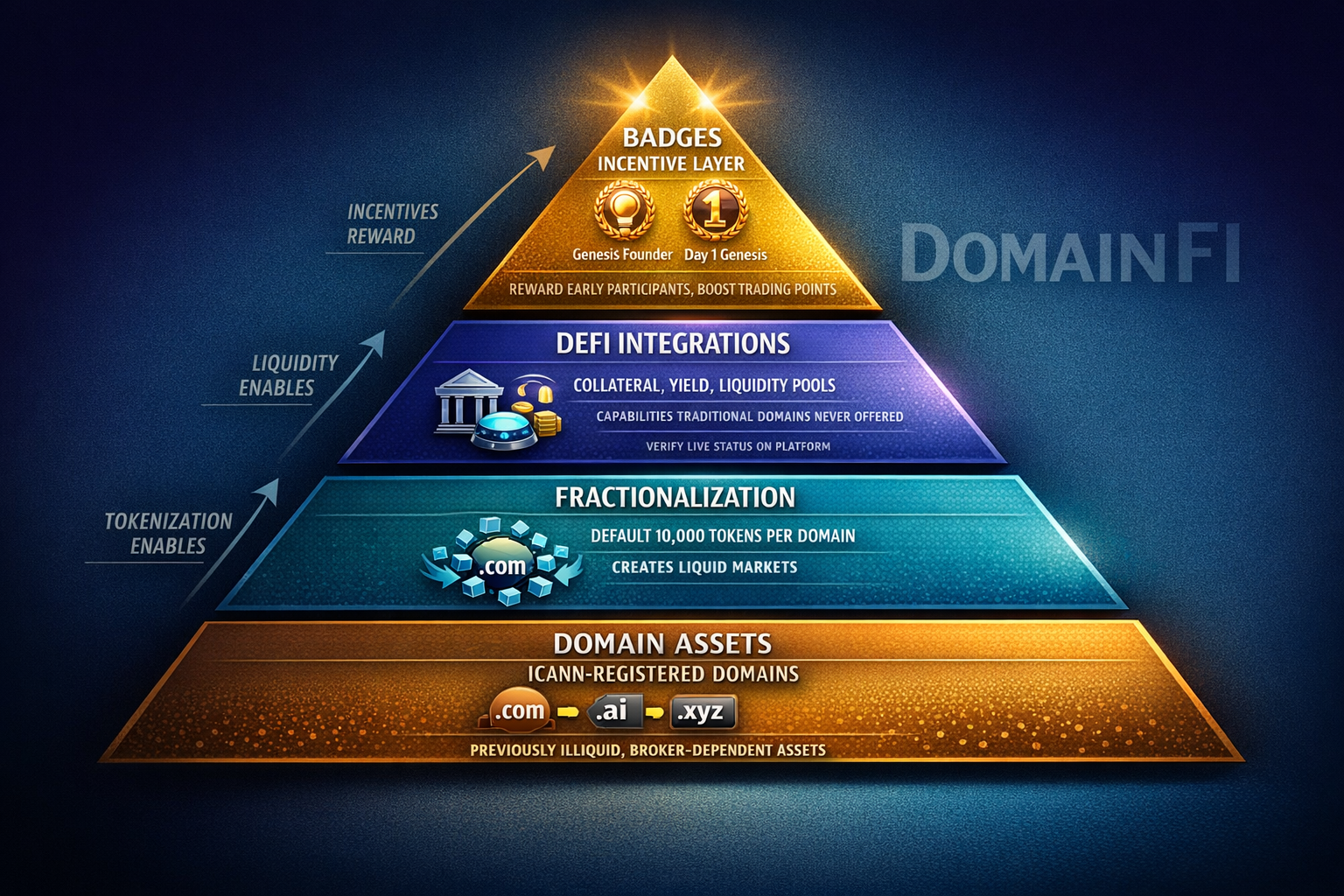
Badges are not an isolated feature. They are the incentive layer sitting on top of DomainFi — the broader set of financial capabilities that Doma enables for domain assets.
Here is what DomainFi currently includes and where it is heading:
›Fractionalization: Any tokenized domain can be split into tradeable ERC-20 tokens (default supply appears to be 10,000 per domain, though this may be configurable), creating liquid markets for assets that were previously illiquid and broker-dependent
›DeFi integration: Domain tokens can potentially be used as loan collateral or deposited into liquidity pools to earn yield — capabilities that traditional domain ownership never offered. The extent to which these integrations are live versus planned should be verified on the platform.
›Cross-chain reach: Via LayerZero, fractionalized domain tokens can move across Ethereum, Base, Solana, and Avalanche, bringing domain liquidity to multiple ecosystems
›Buyback and reconstitution: If someone accumulates a supermajority of a domain's fractional tokens, they can reconstitute the full domain NFT and take sole ownership. The exact threshold has not been independently verified from Doma's documentation — check the protocol's current terms for the precise percentage required before attempting a reconstitution.
›Developer ecosystem: The Doma Forge programme was announced with $1M USDC in grants to developers building on the protocol, accessible at doma.xyz/forge. Verify the current status and remaining allocation before applying, as grant programmes frequently adjust their funding over time.
Badges incentivise the behaviour that makes all of this work: early participation in bonding curves. Without buyers willing to take the initial risk on a newly fractionalized domain, the bonding curve never fills, the token never graduates to open trading, and the domain remains illiquid. Badge rewards are the protocol's way of compensating the people who provide that initial liquidity and price discovery.
What this means for you: Badges reward you for being the type of participant the ecosystem needs most — an early buyer who takes risk on newly fractionalized domains.
The article has referenced Season 2 multiple times, so here is what is and is not known:
What is confirmed:
›The Doma team has indicated that additional seasons will follow Season 1
›Season 1 badges set a template for how early participation is rewarded
What is not confirmed:
›Whether Season 2 will include new badge types
›The eligibility criteria for any future badges
›The timeline for Season 2's launch
›Whether Season 1 badges will carry any benefits into Season 2 beyond their existing lifetime point boosts
The team has not released a Season 2 roadmap or detailed announcement as of this writing. Any claims about Season 2 mechanics beyond the above are speculative.
What this means for you: Do not make financial decisions based on assumptions about Season 2. Watch Doma's official channels for announcements and evaluate each season's mechanics independently.
15
Risks and Limitations
Any guide that describes only the upside is not a guide — it is marketing. Here are the material risks and limitations of the Doma model and badge system that you should understand:
Smart contract risk
Doma's entire system — fractionalization, bonding curves, badge issuance, point tracking — runs on smart contracts. Smart contracts can contain bugs, and exploits have caused significant losses across DeFi. If a vulnerability is discovered in Doma's contracts, user funds and badge functionality could be affected.
Registrar counterparty risk
The underlying domains are held by registrar partners (InterNetX, NicNames, EnCirca, etc.). If a registrar partner revokes, fails to renew, or loses control of a domain, the tokens representing fractional ownership of that domain could become worthless — regardless of what the blockchain says.
Legal enforceability
Token ownership does not equal legal domain ownership in any tested jurisdiction. If a dispute arises over who controls a domain, the registrant of record at the ICANN/registrar level — not the token holder — has the strongest legal standing. The legal enforceability of token-based domain claims is untested in court.
Chain liveness risk
Doma operates on its own Layer 2. If the L2 chain experiences extended downtime, users may be unable to trade, sell, or bridge their assets. While L2s built on the OP Stack have mechanisms for withdrawing to Ethereum mainnet, these may involve delays and are not guaranteed to work smoothly in all scenarios.
Regulatory risk
Domain tokenization and fractionalization sit in a regulatory grey area. Securities regulators in multiple jurisdictions could determine that fractionalized domain tokens constitute securities, which would create compliance obligations for the protocol and potentially restrict user access.
Point system uncertainty
As discussed above, the value of trading points — and therefore the value of badge boosts — is entirely unconfirmed. The team has not committed to any specific conversion, distribution, or utility for accumulated points.
Badge non-transferability
Badges are permanently bound to one wallet. If you lose access to that wallet, the badge and its benefits are gone forever. There is no recovery mechanism.
What this means for you: Participate with full awareness of these risks. Do not invest more than you can afford to lose, and do not treat token-based claims as equivalent to legal ownership.
16
UK Tax and Regulatory Considerations
UK-based participants should be aware of the following under HMRC's cryptoasset guidance (see HMRC's Cryptoassets Manual, CRYPTO61000 onwards):
Taxable events from trading
Every buy and sell of a fractionalized domain token is a disposal event for capital gains tax purposes. HMRC treats crypto assets (including ERC-20 tokens) as property. Each disposal is a potential taxable event, and you must calculate gains or losses based on your cost basis.
Bonding-curve purchases
Bonding-curve purchases may have non-standard cost basis because the price changes with each purchase along the curve. A single purchase may execute across many small fills at incrementally different prices, making cost-basis tracking particularly important.
Badges as potentially taxable receipts
Receiving a badge that has economic utility (via point boosts) may constitute a taxable event under HMRC's guidance. Non-transferable tokens with economic value sit in a grey area — HMRC has not issued specific guidance on soulbound tokens with point-boosting properties. The conservative approach is to record the receipt of each badge and consult a tax professional about whether it creates a taxable event.
Future point conversions
If accumulated points eventually convert into tokens, airdrops, or other rewards, those may create separate taxable income at the point of receipt. The retroactive Season 0 multiplier (Genesis Founder Badge only) increases your point balance — if those points are eventually distributed as value, the increased allocation may carry tax implications.
Record-keeping
Keep detailed records of every purchase timestamp, USDC.e amount, token quantity, and hold period. A crypto tax tool like Koinly can import your Doma L2 transactions and calculate cost basis automatically — especially useful when bonding-curve purchases create dozens of micro-fills at different price points.
Important: This section is informational and does not constitute tax advice. Consult a qualified tax professional familiar with HMRC's cryptoasset guidance for advice on your specific situation.
What this means for you: Do not wait until tax season to organise your Doma transaction history. Track it as you go, and be aware that badges themselves — not just the trades that earned them — may have tax implications.
17
Common Mistakes That Cost People Their Badges
[VISUAL:...]
Even motivated participants lost badge eligibility through avoidable errors. Future seasons will likely follow similar patterns, so these lessons apply beyond Season 1.
›Selling before the 7-day hold completed. Even selling a small portion that drops your remaining position below $10 USDC.e worth can disqualify you. The hold requirement is value-denominated — it tracks the dollar value of your position, not the number of tokens.
›Confusing gross spend with net spend. The Day 1 Genesis Badge requires $10 net. A trader who bought $100 and sold $92 during Day 1 has only $8 net spend — below the threshold despite nearly $200 in total volume.
›Buying after the bonding curve closed. For the Genesis Founder Badge, the purchase must occur while the token is still in its bonding curve (except for $SOFTWARE.ai). Once the curve fills and the token graduates, purchases no longer count — even if it is still Day 1. Similarly, for the Day 1 Genesis Badge, the domain must still be in its Day 1 bonding period at the time of purchase.
›Assuming the domain would bond. The Day 1 Genesis Badge requires that the domain successfully bonds. Buying into a struggling bonding curve that never completes earns no badge.
›Using the wrong wallet or switching wallets. If you started a purchase on one wallet and completed subsequent buys on another, the system evaluates each wallet independently. Badge criteria must be met by a single wallet.
›Not bridging USDC to USDC.e first. Doma operates on its own Layer 2. Purchases must be made in USDC.e (bridged USDC on Doma's L2) or ETH on the Doma chain. Holding USDC on Ethereum mainnet does not count. See the bridging section above for step-by-step instructions.
What this means for you: Badge eligibility is precise. Future seasons will almost certainly have similar fine-print conditions — read every requirement carefully before the window opens, not after it closes.
Day 1 Genesis Badge Eligibility
✓
Net spend (buys minus sells) of at least $10 USD
✓
Purchased while domain was still in Day 1 bonding period
✓
Purchase made before midnight UTC on 1 April 2026
✓
Held position for minimum 7 consecutive days
✓
The purchased domain successfully bonded
18
Quick Recap
›Genesis Founder Badge: closed forever, exclusive to three original domain launches ($SOFTWARE.ai, $BRAG.com, $BONER.com), grants 1% lifetime boost plus 2× retroactive Season 0 multiplier
›Day 1 Genesis Badge: deadline of midnight UTC on 1 April 2026 (verify whether this has passed based on your current date), available for any fractionalized domain, grants 1% lifetime boost only
›$SOFTWARE.ai bonded in one block: bonding-curve requirement waived for that token only — a unique exception due to automated sniping bots filling the curve within a single block
›Both badges require a 7-day hold of at least $10 USDC.e worth — value-denominated, not token-count
›Whether both badges' 1% boosts stack has not been officially confirmed — do not assume a combined 2% boost
›Trading points have no confirmed conversion — the team has not announced what points will ultimately be worth
›Token ownership is not legal domain ownership — understand the custodial and legal structure before committing funds
›Check your badges at app.doma.xyz → connect wallet → profile → Awards tab
Disclosure: Links to app.doma.xyz in this article use a referral parameter (join/4urmvv4ouvvsu). You can navigate directly to app.doma.xyz without it. Affiliate links to MEXC, Ledger, and Koinly are also used in this guide and may generate commission for this publication.