Pricing the Future: Ish Milly's Domain Investing Playbook
In a 68-minute AMA recorded on May 14, 2026, domain investor Ish Milly breaks down how he built a ~3,000-name portfolio and sold over $350,000 in domains in a single year. The conversation covers his Clubhouse origin story, hand-registration strategy, pricing psychology, why .com still dominates, and where tokenization fits into the future of domain investing.
→A hand-registered domain costing under $75 can yield thousands if you counter aggressively rather than accepting the first inbound offer.
→Geo names paired with trending extensions (like .club during the Clubhouse era) can be high-value plays when timing aligns with cultural momentum.
→Most hand-registered domains are liabilities, not assets, portfolio discipline matters more than volume.
→Building real relationships with industry veterans (brokers, seasoned investors) accelerates learning far beyond any course or content.
~3,000
Names in Ish's portfolio
~$42,000
Annual renewal cost
$350,000+
Domain sales in 2025
18 months
Time to first sale
Ish Milly spent $37 on a domain name, woke up to a $1,000 offer in his inbox, and did the one thing most people wouldn't do, he turned it down. He countered at $10,000. The buyer came back at $5,000. They settled at $7,000. That domain was artauctions.io, a hand registration that cost him roughly $75 all-in with one renewal. And it was just the beginning. Since then, Ish has sold over $350,000 worth of domains in a single year, built a portfolio of roughly 3,000 names, and founded Domainer Expo, one of the industry's growing conferences. All of this started because he walked into the wrong Clubhouse room during the pandemic.
I sat down with Ish for a 68-minute AMA on May 14, 2026, and what came out wasn't the usual "buy low, sell high" platitudes. It was a masterclass in how a web3-native entrepreneur thinks about domain investing as both a business and a wealth-building vehicle, including where tokenization fits, why .com still dominates, and why the name you hand-registered last week is probably a liability.
Here's what you need to know.
01
The Clubhouse Origin Story Nobody Planned
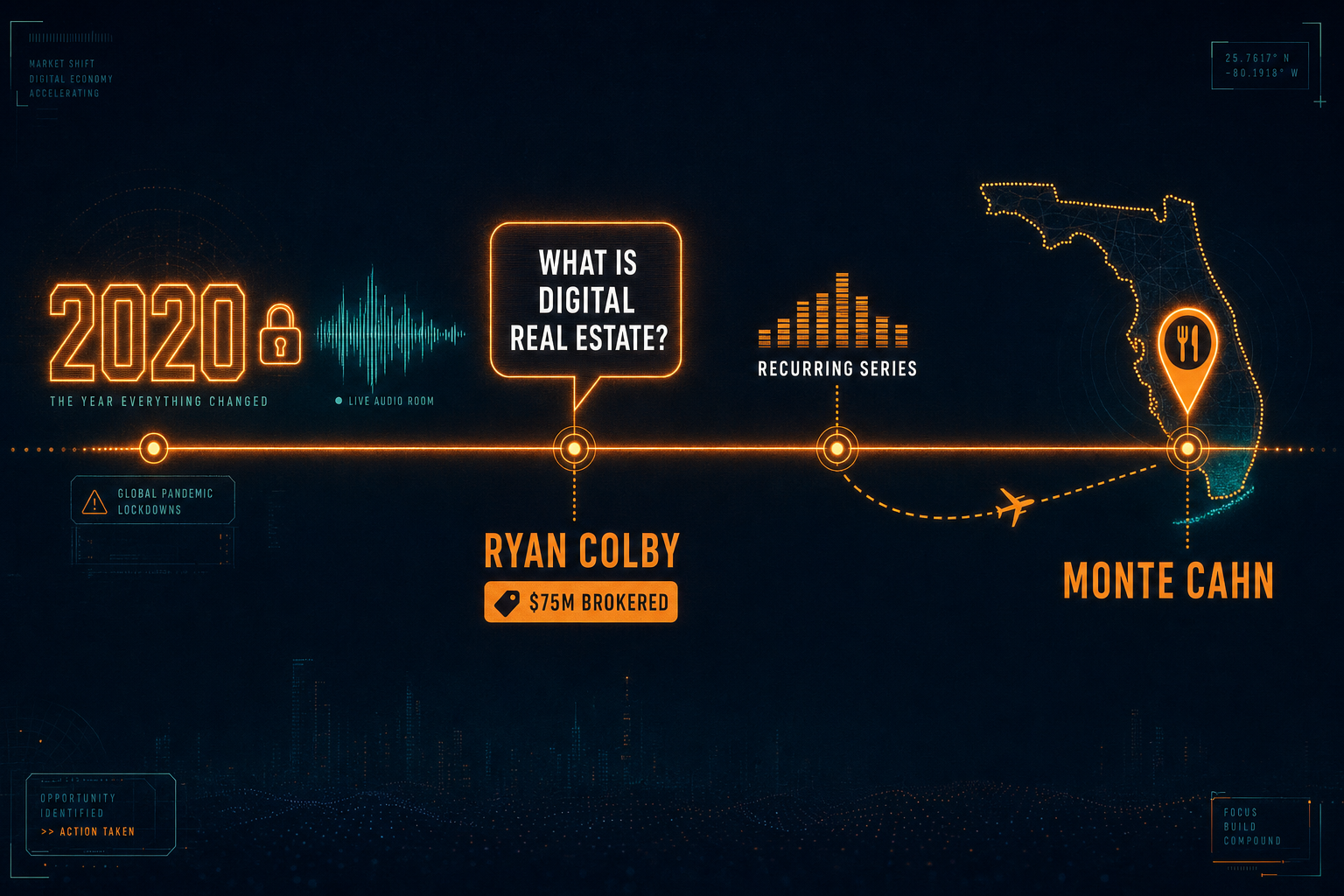
A cinematic timeline showing the chain of serendipitous encounters from Clubhouse rooms to domain in
A cinematic timeline showing the chain of serendipitous encounters from Clubhouse rooms to domain in
It's 2020. The world is locked down. Ish is on Clubhouse with about 17,000 followers, running rooms about e-commerce, specifically helping people set up Shopify stores. He starts a room called "What Is Digital Real Estate," expecting it to funnel people toward his Shopify content. Instead, a guy named Ryan Colby joins and flips the entire premise.
Ryan identified himself as a domain broker who had sold Instagram their domain name and had brokered over $75 million worth of domain deals. Ish went from moderating to interrogating. The session became a recurring series. More listeners piled in. Ryan started bringing other domain veterans onto the stage, including Monte Cahn, a well-known domain investor. Ish flew to Florida to meet Monte in person. Monte had a restaurant there, and through Monte got introduced to Rick Schwartz, known in the industry as the "Domain King."
That Clubhouse pipeline, from random room to real relationships, led Ish and Ryan to co-found the Digital Real Estate Academy, which did six figures in its first week selling a domain investing course. But the education wasn't just for students. Ish was learning in real time.
His first investment-grade purchase was miami.club for $800. Ryan told him it was "a great pickup", a geo name paired with the .club extension during a moment when Clubhouse had made "clubs" culturally relevant. He recently sold that name in March 2026 for low five figures. From that starting point, Ish started buying names almost every day, made what he openly calls rookie mistakes with speculative .club names, and gradually migrated his portfolio toward .com and .ai.
The lesson here isn't "go find a Clubhouse room." It's that domain investing, like most of web3, is a relationship-driven asset class. Ish got educated by people who had already made the expensive mistakes. He didn't skip the tuition, he just paid it in attention instead of blown registrations.
02
The Numbers Behind a 3,000-Name Portfolio
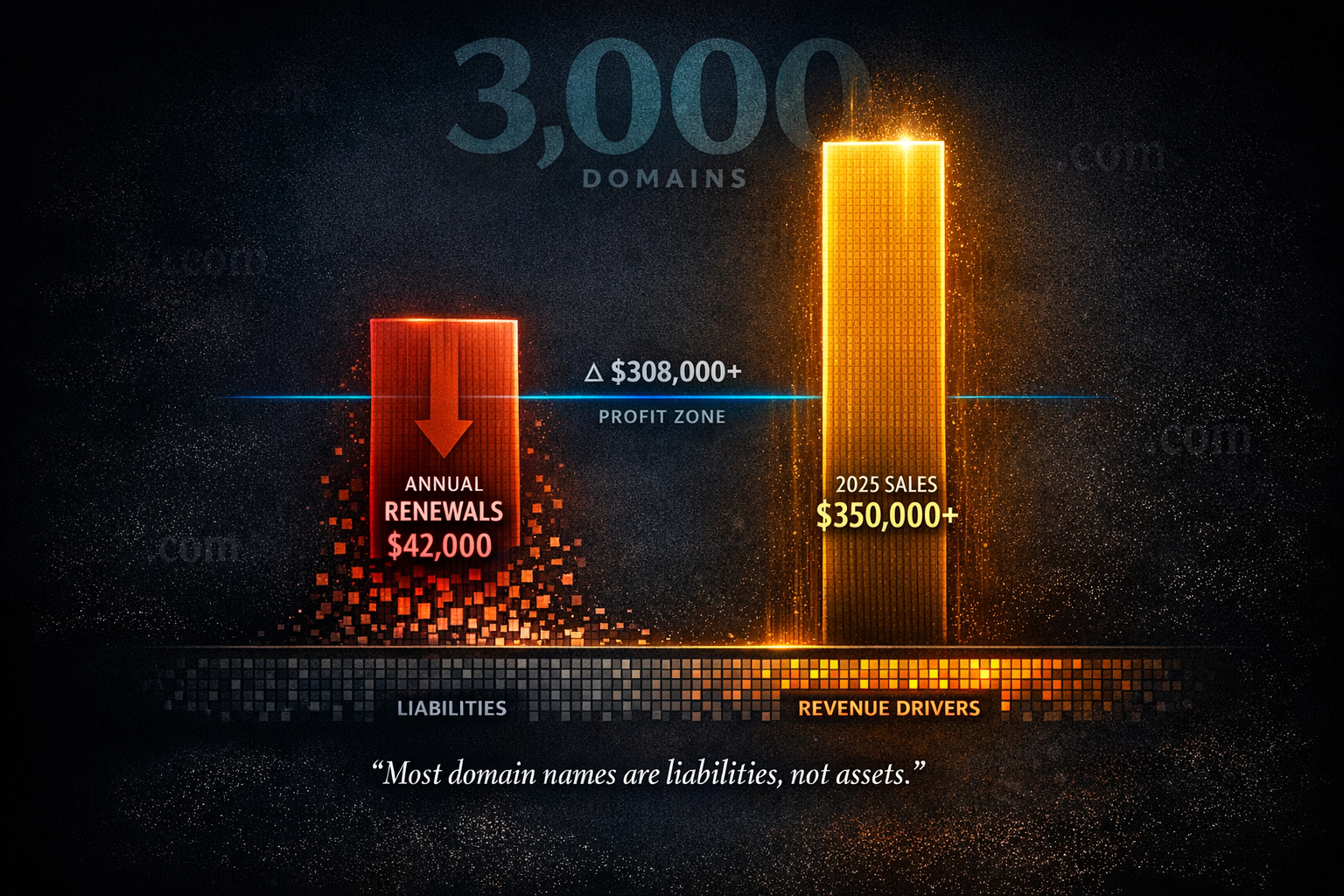
A dramatic data visualization contrasting 42K annual renewal costs against 350K sales revenue across
A dramatic data visualization contrasting $42K annual renewal costs against $350K+ sales revenue acr
Let's talk about what running a real domain portfolio actually looks like, because the numbers are sobering.
Ish holds approximately 3,000 domain names. His annual renewal bill is around $42,000. That's $42,000 going out the door every year whether he sells a single name or not. Against that, he generated $350,000+ in sales in 2025, and he says the year before was even larger. So he's profitable, meaningfully so. But he's also the first person to tell you that most of those 3,000 names will never sell.
As Ish put it on the AMA: "Most domain names are liabilities, not assets, because there is a renewal cost."
This is the thing web3 people need to hear, because we come from a world where minting an NFT and holding it in a wallet costs nothing beyond gas. Domains are different. Every name has a clock attached to it. Miss a renewal and you lose the asset. Pay the renewal on a name nobody wants and you're just feeding dead weight. Ish describes his portfolio management process as identifying "the dead weeds in the garden." If a name has sat for three years with zero inquiries, logic has to override emotion.
He's systematized this with a Claude-based star rating system. He pastes a domain into Claude and asks for a one-to-five-star viability rating. Five stars means never sell, hold forever. One star means drop it at the next renewal. Two to three stars is speculative territory, be careful. Three-plus stars with data backing it up is a hold. This isn't a magic oracle. It's a framework for forcing decisions on a portfolio that's too large to evaluate by gut feeling alone.
The broader point: this is a business with real operating costs. The portfolio model only works if your winners pay for your losers with room to spare. Ish's winners pay handsomely. But that $42,000 annual nut is always ticking.
⚠
Domains Have Carrying Costs
Unlike NFTs sitting in a wallet~ domains cost $10–$120/year to renew. A 100-name portfolio of .com names costs ~$1,000/year. That's real money burning if nothing sells. Budget for renewals before you buy.
03
The Sales That Prove the Model
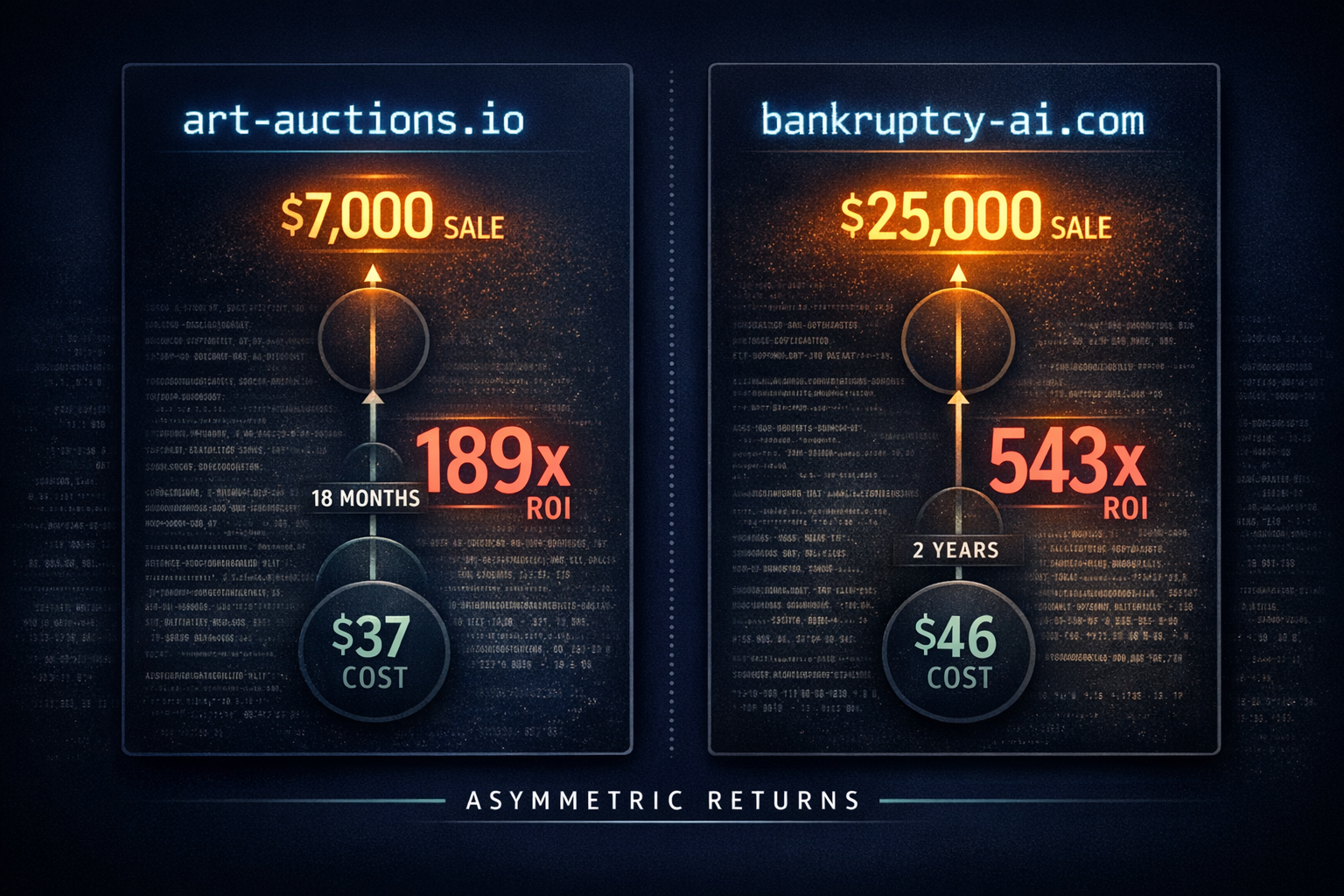
A sidebyside comparison of two landmark domain deals showing acquisition cost versus sale price with
A side-by-side comparison of two landmark domain deals showing acquisition cost versus sale price wi
Let's look at the actual receipts, the sales that turned Ish from curious Clubhouse listener to full-time domain investor.
artauctions.io. This was the one that made it real. He hand-registered it for $37, spent about $75 total after one renewal. Woke up to a $1,000 offer. His mentors had already drilled into him: never accept the first offer. He countered at $10,000. The buyer came back at $5,000. They closed at $7,000. It took about 18 months from registration to sale. As Ish describes it, this was the moment he knew domain investing wasn't theoretical.
bankruptcyai.com. Bought for $466 on a thesis that keyword + "ai" + .com names would appreciate as the AI industry matured. That thesis paid off in about a year. He sold it in June 2025 for $19,999. A 43x return, but only if you had the patience and conviction to hold through a year of patient holding.
nouns.org. Sold to the Nouns DAO community for $52,500, and the buyer tipped him an additional $2,500. The DAO hadn't even built anything on it yet, but they recognized the pattern: Ethereum.org, Solana.org, Bitcoin.org. A DAO needs the .org. Ish had it.
psychiatristlosangeles.com. Bought for $1, sold for $4,888 via an inbound GoDaddy offer with zero outbound effort. After GoDaddy's 25% commission, he netted approximately $3,900. What he did next is instructive: he immediately picked up other psychiatrist-keyword-geo names and priced them at the same price point. One sale became a category strategy.
prepaidai.com. Sold for $35,000, and the buyer brought Ish on as a marketing advisor to their startup. This is the layer most domain content skips: when you build a real reputation in a niche, the right sale doesn't just close, it opens doors. A one-time transaction became an ongoing relationship and another revenue stream layered on top of the original wire.
lemonlawlawyer.com and foodies.club. Two early wins from very different lanes. Lemonlawlawyer.com is a long-tail legal-services keyword nobody was watching. Ish picked it up for $1,300 and sold it for $14,999. An 11x return that came from owning a name with clear commercial intent and waiting patiently for the right buyer to find it. Foodies.club went for $2,500 during the early .club era; that one worked because the timing was right. Clubhouse had made ".club" culturally legible. Most of his other .club speculation did not work out, which is exactly why he shifted to .com.
By the numbers
$7,000
art-auctions.io exit
$25,000
bankruptcy-ai.com exit
$52,500
nouns.org sale
$4,888
psychiatrist-los-angeles.com
04
The Art of Not Accepting the First Offer
Ish uses a poker analogy for negotiation that's worth internalizing. When an inbound offer arrives, the buyer has already shown their hand. They want the name. Since the vast majority of names in any portfolio will never sell, the sell-through rate problem, the ones that do attract offers need to be negotiated upward to compensate for all the dead weight.
As Ish put it on the AMA: "Don't ever accept the first offer. Always negotiate."
But there's a subtler psychological layer he described. When you accept a first offer instantly, the buyer often doesn't feel good about it, they feel suspicious. "When you accept the first offer, psychologically, the person feels like, oh, maybe I'm way too much money. And then they might start looking at all the names or kind of store you out." The negotiation process itself builds confidence in the transaction.
He says he's turned $300 offers into $20,000 sales by negotiating. Not every time, obviously. But the principle holds: your first reaction to an inbound offer should be curiosity about what the buyer actually values, not relief that someone finally wants to pay.
1
Inbound Offer Arrives
The buyer has already revealed interest — you have leverage
2
Resist the Impulse
Accepting immediately can spook the buyer into thinking they overpaid
3
Counter High
Ish counters at 2-3x what he'd accept — gives room to negotiate down
4
Find the Middle
Most deals close between your counter and their opener
5
Close and Learn
Use the final price to set comps for similar names in your portfolio
05
.com Is Still King (and Why That Matters for Web3 Natives)
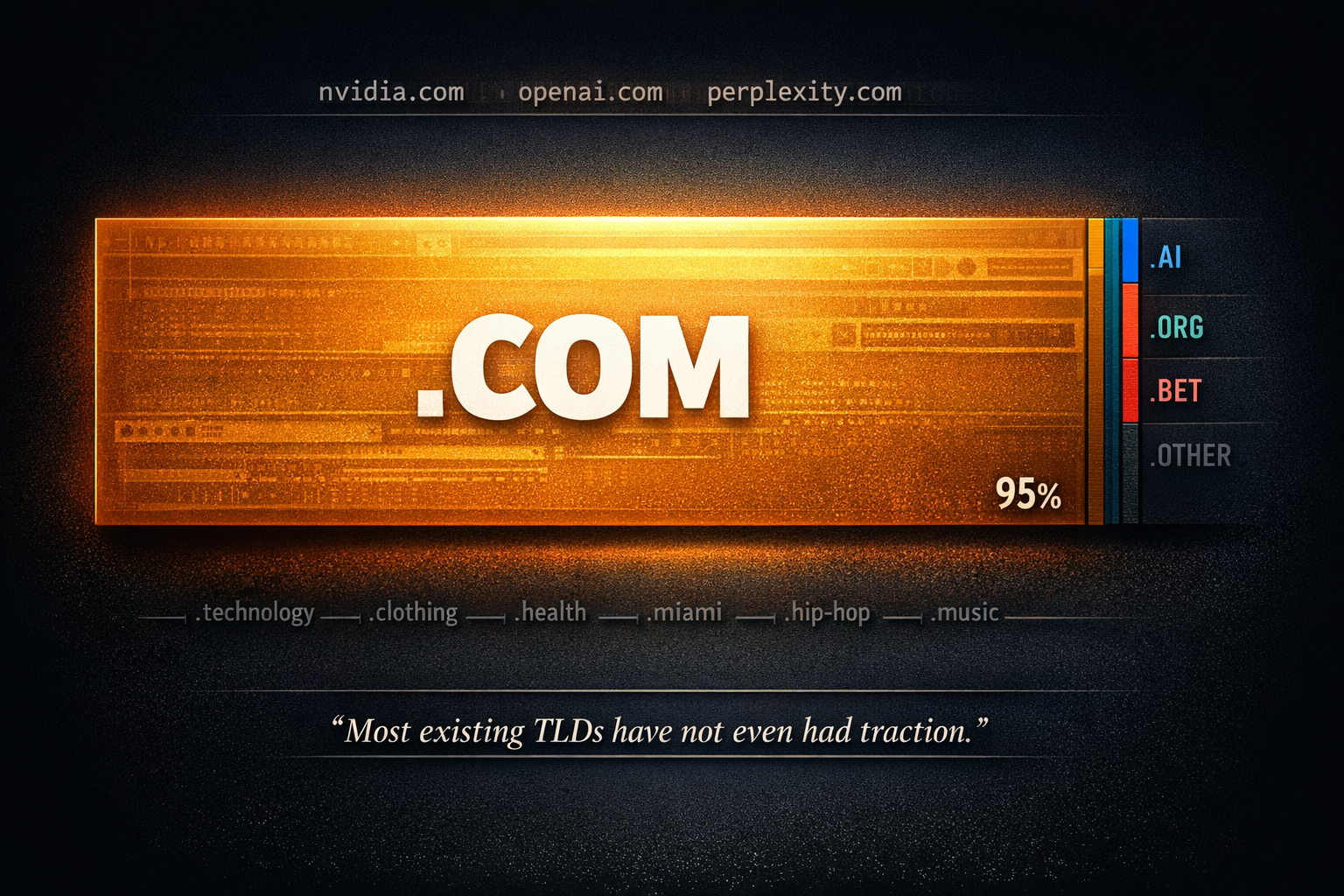
A dominant data visualization showing com as an overwhelming 95 of portfolio allocation with other T
A dominant data visualization showing .com as an overwhelming 95% of portfolio allocation with other
Here's the part that might sting if you've been loading up on exotic extensions: at least 95% of Ish's portfolio is .com.
He's not dogmatic about it, he holds some .ai, some .org, even a .bet position, but he's clear-eyed about what actually sells. Founders naturally look for .com first. They fall back to .io. Maybe they try a newer TLD. But as businesses mature and raise capital, they come back for the .com. Every top AI company reinforces this. Nvidia, OpenAI, Claude, Perplexity. All .com.
On new TLDs, Ish is blunt: "Most of the existing TLDs haven't even had traction. So the new ones coming are going to be, they're not going to be something that I'm going to rush and buy personally." He rattles off the evidence: .technology, .clothing, .health, .miami, .hip-hop, .music, .shoes, none have gained meaningful traction. Polymarket is polymarket.com. Kalshi is kalshi.com. PredictIt is a .com. None of them use .predict or .bet as their primary domain.
The renewal cost math makes alternative extensions even harder to justify speculatively. Some alternate TLDs cost $60–$120 per year to renew versus roughly $10 for a .com. At those prices, you're paying a premium to hold an asset that the market values less.
His rule of thumb: "I'd rather own a keyword-health.com than own a .health."
He does acknowledge that .ai has shown real strength because of the sheer cultural momentum of artificial intelligence post-ChatGPT, and .bet has had some traction (Lone Star.bet sold for $70,000, another name went for $150,000). He picked up prediction.bet as a calculated position. But these are the exceptions that prove the rule. For investment-grade holdings, .com is still the floor.
.com
95% of Ish's portfolio
✓30 years of history and trust
✓Every top AI company uses it
06
Pricing: The Skill Nobody Teaches
A stepbystep flow diagram showing how multiple data signals converge into a defensible domain asking
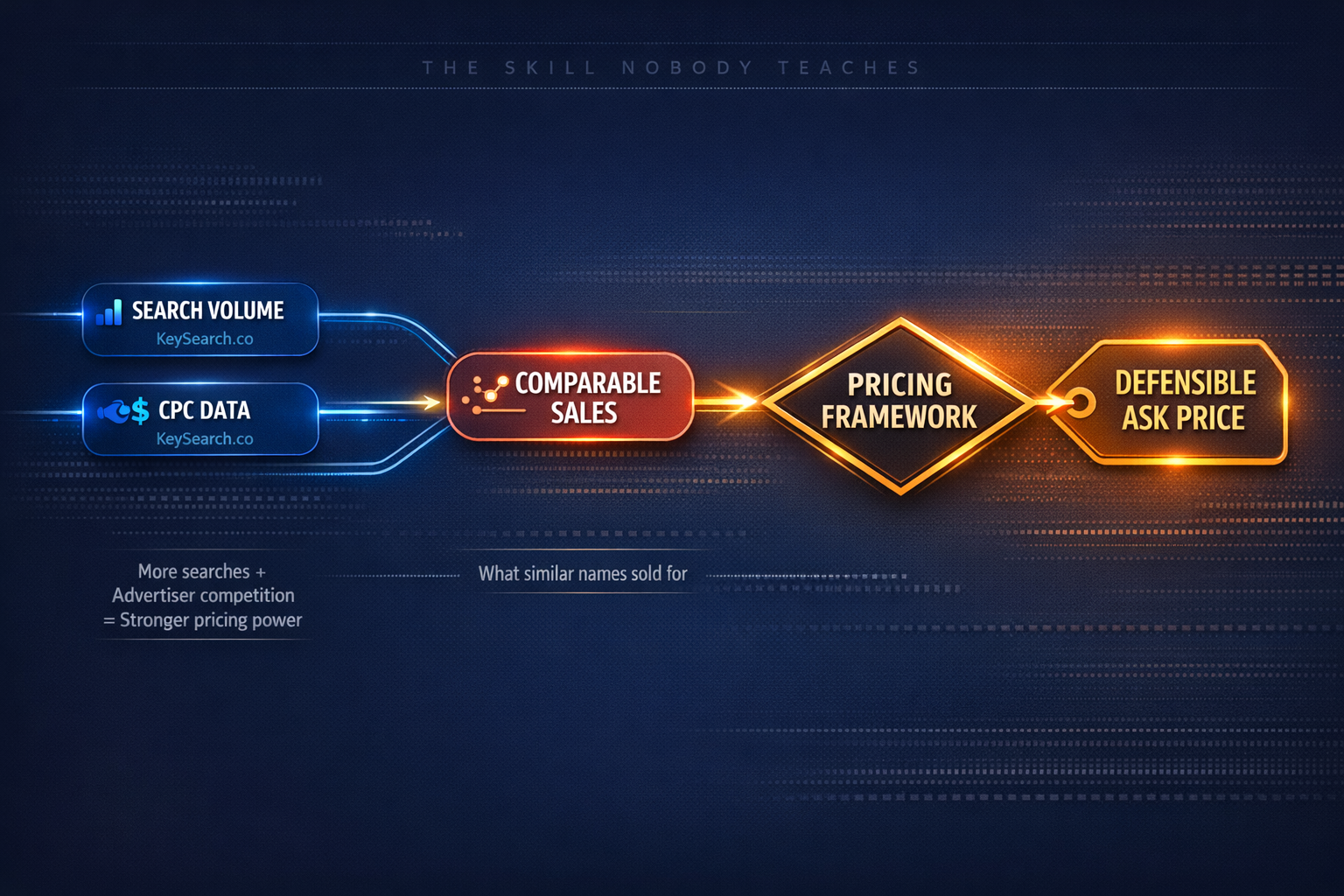
A step-by-step flow diagram showing how multiple data signals converge into a defensible domain aski
If negotiation is the closer, pricing is the opener, and Ish calls it "a skill that will affect your profitability" more than almost anything else.
The problem is that the domain industry's appraisal tools are, in his words, "very bad." You'll get one tool saying a name is worth $3,000 and another saying it's worth nothing. There's no Bloomberg terminal for domain names. So Ish built his own framework using multiple signals:
KeySearch.co for search volume and CPC (cost per click) data. If a domain's keywords are being actively searched and advertisers are competing for those keywords, that's a pricing signal. More searches plus advertiser competition equals stronger pricing power.
Comparable sales from recent transactions. He studies what similar names have sold for to establish realistic ranges. The psychiatristlosangeles.com sale at $4,888 didn't just make him money, it gave him a comp to price his other psychiatrist-geo names.
Claude and ChatGPT for research and analysis. He uses them to dig into why certain sales happened, to identify what a potential buyer might value about a name, and to stress-test his own pricing assumptions.
Recent funding news. If a sector is seeing venture capital inflows, the companies receiving that money will eventually need category-defining domains. Ish tracks who's raising and why, which reveals where demand is heading before it shows up as inbound offers.
Underpricing leaves money on the table. Overpricing means you miss entirely. The answer isn't some median, it's doing the work to understand what a specific buyer would pay for a specific name in a specific market moment.
→
Pricing Is a Skill~ Not a Guess
Ish calls pricing 'a skill that will affect your profitability.' He uses CPC data from KeySearch.co~ comparable sales from recent transactions~ and AI analysis from Claude and ChatGPT to triangulate a realistic range. Appraisal tools in the domain industry are 'very bad' — one will say $3,000 and another will say nothing.
07
Sometimes You Build Instead of Sell
A conceptual forkintheroad illustration showing the choice between flipping a domain for quick profi
A conceptual fork-in-the-road illustration showing the choice between flipping a domain for quick pr
Here's where Ish diverges from the pure domain-flipper playbook and starts sounding like the entrepreneur he is.
He had an offer for aiagentssummit.com that would have been a huge profit on the original cost. But Ish is a conference organizer, that's his core skill set. Instead of taking the exit, he built a real event on the domain. As he told the AMA audience, that decision "will make me way more money than I can ever sell that name for."
Same pattern with his Prediction Markets Conference. The inaugural event ran last month and the second edition is in November. He's already had a $500,000 offer to buy the conference itself, which he respectfully declined. The domain was the seed, but the business growing on top of it is worth multiples of the domain's standalone value.
His advice to the web3 audience: "Look at names that you can build and turn into wealth."
This is particularly relevant for web3 natives who already have communities, technical skills, or niche expertise. A domain isn't just a flip target. If you know a vertical deeply enough, the right domain can be the foundation for a media property, an event brand, a community hub, or a product. The domain is the land. What you build on it determines the real value.
08
The Tokenization Angle: Where DOMA Fits
Now let's talk about the elephant in the room for this audience. Ish doesn't just theorize about domain tokenization, he's done it. He tokenized trenches.ai on DOMA and has very specific reasons why.
The backstory: he wanted trenches.com but the owner wanted $900,000, which wasn't feasible. He held trenches.ai but was sitting in a bear market with no inbound offers. The traditional path would be to list it on a marketplace and wait, maybe years, maybe forever. Instead, he tokenized it on DOMA to create awareness and fractional ownership. Over 100 people now co-own a piece of the name.
Ish draws a direct line from NFTs to tokenized domains, and his framing is sharp: "With NFTs, it was all backed by art. But most people that were in NFT communities don't give a shit about art. They just care about yield. In this situation, domains are a lot more stable than digital art."
He sees meme coins as a social experiment and believes that as degens mature from getting burned, "you can only get burnt for so long, they're going to evolve", they'll gravitate toward tokenized real-world assets like domains. The asset is tangible. It has a market. It generates revenue when sold or developed. It's not a JPEG hoping for cultural relevance.
His strongest signal for conviction isn't vibes, it's institutional backing. He points out that Coinbase Ventures and Paradigm invested in what DOMA is building. As he put it: "These people have a lot more insight into what's going to happen. They have more to lose than you do by putting money behind it, and you just go in the flow of currency. That's how you make money."
He also laid out a community-building thesis around tokenized names. If trenches.ai reaches 500 holders, he committed to building something meaningful for that community, potentially a Discord, utility features, or visibility initiatives. It currently has about 109 holders. The logic is sound: a tokenized domain with an active community becomes more than an asset; it becomes a brand with built-in distribution. He says he wouldn't be surprised to see a tokenized name eventually going for millions of dollars.
For those of us who've watched the web3 cycle play out, from NFTs to DeFi to meme coins to real-world assets, this framing resonates. The infrastructure is finally matching the intuition. Fractional ownership of premium digital assets, with transparent on-chain provenance and community co-ownership, is the kind of thing web3 was always supposed to enable. Domains just happen to be one of the most liquid and well-understood digital asset classes to plug into that model.
◆
Why Ish Tokenized trenches.ai on DOMA
He wanted trenches.com but the owner wanted $900K. Rather than waiting for a single buyer in a bear market with zero inbound offers on trenches.ai~ he tokenized it — creating awareness and fractional ownership. Over 100 people now co-own a piece of the name.
09
Be Early on Emerging Keywords. But Don't Be Reckless
Ish's .ai names were picked up in 2023, before AI became a mainstream consumer conversation. bankruptcyai.com cost him $466. It sold for $19,999 two years later. That's the kind of return that makes people rush to hand-register 50 names tonight. Which is exactly what Ish warns against.
His method for identifying emerging keywords is systematic, not impulsive:
Read the news. Track who's raising money and in what sectors. If three prediction market platforms raise $50M+ rounds in a quarter, prediction-related keywords are about to get expensive.
Study recent sales. Trend signals show up in comparable sales data before they show up in mainstream coverage. He uses Claude to research why unexpected sales happened, like why did a niche name like Clearwater Lawn Bowling Club.org sell for $3,950?
Attend or organize industry events. Ish runs the Prediction Markets Conference and Domainer Expo. Being in the room where deals happen gives him signal that sitting behind a screen doesn't.
Leverage your web3 edge. This is his specific advice to this audience. If you understand crypto, AI agents, tokenization terminology, and what KOLs and influencers are talking about, you have an edge over traditional domainers who don't. Pick up web3-native names that reflect emerging concepts, but only after doing the research to confirm demand.
He walks the talk. He picked up Tokenfy.com for $3,000 and won't sell it for less than $350,000 because of his conviction in the category. That's not recklessness, it's a thesis with a price tag.
10
Don't Just Wait. Outbound Your Names
One distinction Ish makes that separates him from passive domain investors is his approach to outbound prospecting. Most domain investors list their names on GoDaddy, Afternic, or Dan.com and wait for the "name sold" email. Ish does that too, but he doesn't stop there.
He proactively identifies potential buyers and connects them with names he thinks they'd want. This means researching companies in relevant verticals, finding the decision-makers, and reaching out directly. It's sales work, plain and simple, but it dramatically increases the probability of closing deals rather than hoping someone stumbles onto a listing.
He also lists across multiple marketplaces and uses emerging distribution channels, including tokenization, to increase visibility. A tokenized domain on DOMA, for instance, doesn't just create fractional ownership. It creates awareness. Over 100 people now know trenches.ai exists and have a stake in its success. That's distribution you can't buy on a traditional marketplace.
As he puts it, outbound helps him "close that gap of making a sale." In an asset class where the sell-through rate is brutally low, anything that increases the surface area for discovery is a competitive advantage.
11
The Honest Truth About Domain Investing
Here's where I want to channel Ish's most important message, because it's the one most people will skip past in their excitement.
"If you go out there and you buy 100 domains today out of excitement, chances are you're picking up liabilities instead of assets."
He warns that domain investing is "very addictive" and that the ease of putting a credit card down and buying a name should make you suspicious, not excited. His exact framing: "Why was it so easy to get this name? Why is it so available? If it's easily available, and there are hundreds of thousands of people out there buying names, and no one ever thought about buying it, that should make you suspicious."
This is the single most important filter for web3 natives entering the domain space. We're used to minting things. Aping into things. Acting on excitement and sorting out the thesis later. Domains punish that behavior because every registration comes with an annual renewal cost. An impulse buy of 100 names at $10 each is $1,000 upfront and $1,000 every year after that, forever, until you either sell them or let them drop. Multiply that by the 95%+ of names that will never generate an offer and you see why Ish spends so much time talking about portfolio pruning.
"Not everything that glitters is gold."
His first sale took 18 months. The bankruptcyai.com thesis paid off in about a year. This is a slow-yield asset class. It builds wealth quietly, compounding over years, not weeks. As he put it: "Domain investing is one of those things where it's not a get rich overnight opportunity, but it's a wealth building hack, because next thing you know, you have a portfolio that's worth a couple of million dollars."
That framing, wealth building hack, not lottery ticket, is the right one.
⚠
The Addiction Warning
Ish calls domain investing 'very addictive.' The ease of putting a credit card down should make you suspicious~ not excited. Ask yourself: why was this name so easy to get? If hundreds of thousands of domain investors passed on it~ that's a signal.
12
What to Do With This
If this AMA gave you one thing, let it be this: domain investing rewards research, patience, and discipline. It punishes excitement, impulse buying, and the assumption that what's available is what's valuable.
Here's your action list:
Get educated before you spend. Follow domain investors on X and let the algorithm expose you to experienced voices. Ish hosts what he describes as the most-attended weekly domain podcast on X, start there. Follow him at @ishmilly (I-S-H-M-I-L-L-Y) on every platform except LinkedIn.
Use your web3 edge. You understand crypto, AI agents, tokenization, and emerging terminology better than most traditional domainers. That's a real advantage. Apply it to identifying keywords and concepts before they go mainstream.
Build a research stack. Claude for star ratings and viability analysis. ChatGPT for trend research. KeySearch.co for CPC and search volume. Comparable sales for price discovery. This isn't optional, it's how you avoid paying renewal fees on names nobody wants.
Start with .com. Ninety-five percent of Ish's portfolio is .com for a reason. If you're going to hold alternative extensions, have a specific thesis for each one and be honest about the higher renewal costs.
Explore tokenization on DOMA. If you want to understand how fractional domain ownership works in practice, go to doma.xyz and look at what's happening with trenches.ai and other tokenized names. This is where the web3 mechanic meets the web2 asset class, and it's early enough that the learning itself has value.
Be patient. Ish's first sale took 18 months. His biggest thesis plays took two to three years. If you're looking for overnight returns, this isn't your asset class. If you're looking to build a portfolio that compounds quietly into something worth seven figures, the playbook is right here.
As Ish closed the AMA: "We're still very early, but it's going to get real, very fast."
He's not wrong. And now you have the framework to be ready when it does.